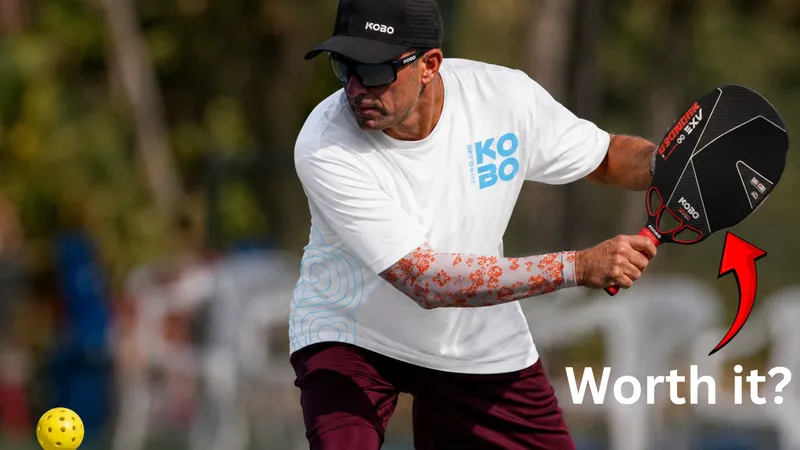
There's an argument happening at your local courts right now, and you've probably already walked past it.
It usually starts the same way. Someone shows up to open play holding a paddle that doesn't look like a paddle. The handle is long. The head has these strange scooped-out channels near the throat, like something off the wing of a fighter jet. People notice it from two courts away.
Then somebody asks the question that always gets asked: "How much was that?"
And the answer — $399 — is where the room splits in half.
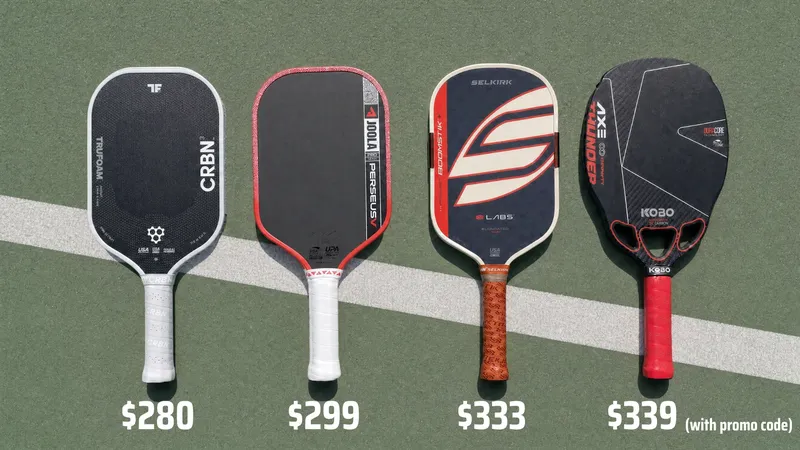
Half the players laugh. Four hundred dollars for a pickleball paddle? When a perfectly good JOOLA or CRBN runs $280 to $300? "There are such good alternatives for much cheaper," one longtime player scoffed. To this camp, the KOBO Thunder Axe is everything wrong with a sport that's gotten a little too rich for its own good — a status symbol for people with more money than dinks.
The other half goes quiet. Because that half has played with it. And they're not laughing.
Why this fight is happening now
To understand how a single paddle became the most polarizing piece of gear in pickleball, you have to understand the moment the sport is in.
Pickleball is no longer the backyard novelty your uncle picked up during lockdown. It's the fastest-growing sport in America, the courts are full, and the players who started three years ago are now genuinely good — 3.5, 4.0, and climbing. That maturation has set off an arms race. Paddles got dramatically faster, 'spinnier', and more durable almost overnight — and brands are racing to out-engineer each other for an edge serious players gladly pay for.
Into that arms race walked KOBO Sports, an Arizona company with a paddle that ignored almost every convention at once — and a price tag that dared you to take it seriously. It was officially approved by USA Pickleball on March 5, 2026, which means whatever it is, it's tournament-legal. This is not a gimmick you can't actually compete with.
So we did what any gear desk would do. We dug into the reviews, the tournament results, and the build itself to answer the only question that matters: is the Thunder Axe all hype, or are the quiet ones onto something?
First, the case for the skeptics
Let's be fair to the doubters, because they're not wrong about everything.
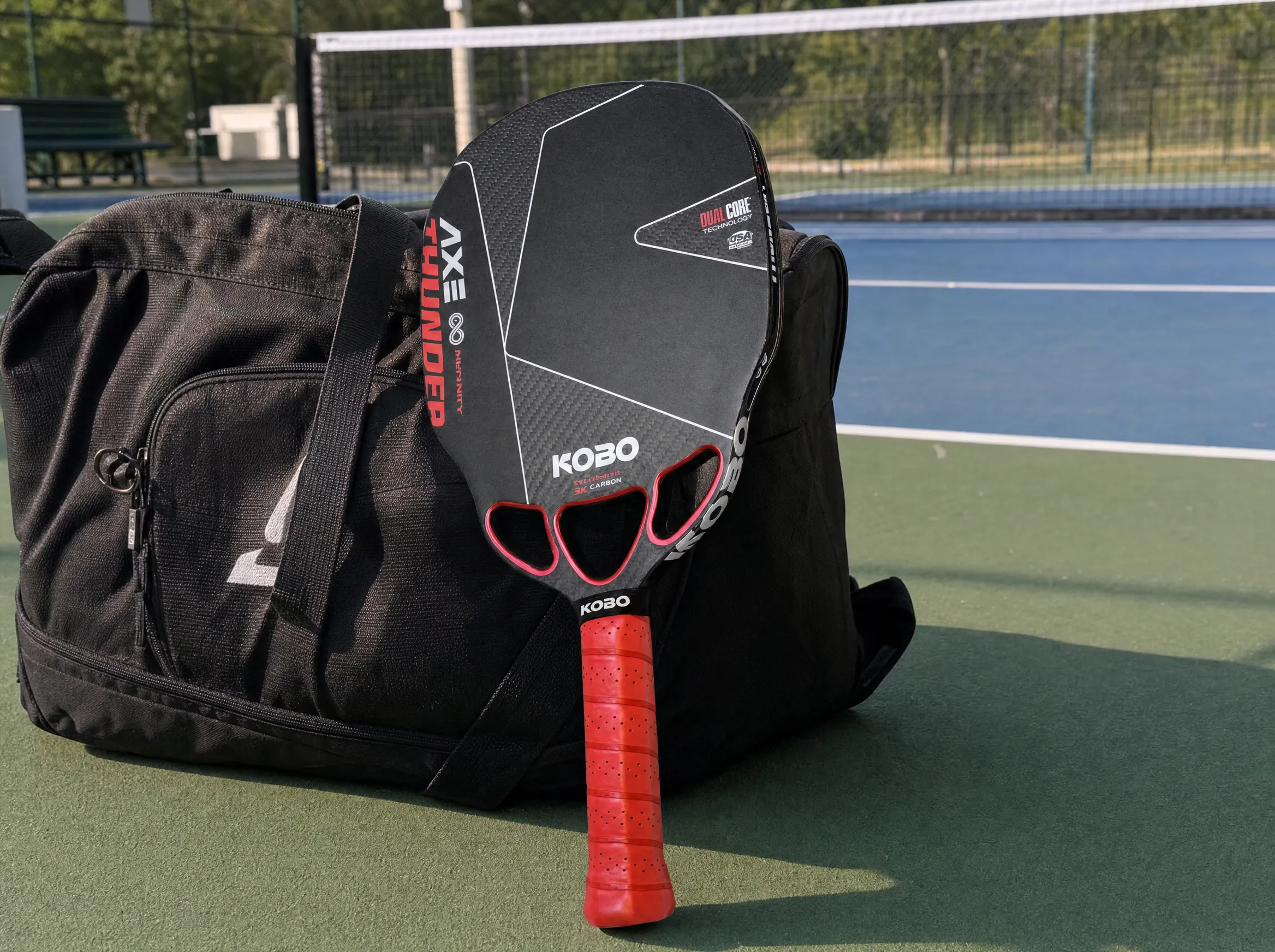
The Thunder Axe is genuinely demanding. Because it's edgeless — no plastic guard around the rim — the margin for error shrinks. Catch the ball clean in the center, what players have started calling "dead red," and it's glorious. Catch it on the frame, and, in the blunt words of one reviewer, "when you hit the frame it's just game over."
It's also not a cannon out of the box. If your game is built on swinging from your heels and "knocking the snot out of it," you may find the Thunder Axe oddly polite at first. Several testers added lead tape to the perimeter to wake up its power and widen the sweet spot.
So if you're a beginner, or a banger who lives for the put-away, the skeptics are right — this probably isn't your paddle, and you'd be crazy to spend $399 finding that out.
But that's exactly what makes the other half of the argument so interesting. Because the people raving about this thing aren't beginners. They're some of the most demanding players and reviewers in the sport. And they're describing an experience that sounds almost nothing like the price tag suggests.
What it feels like to play with
The first thing everyone mentions is the weight — or the apparent lack of it.
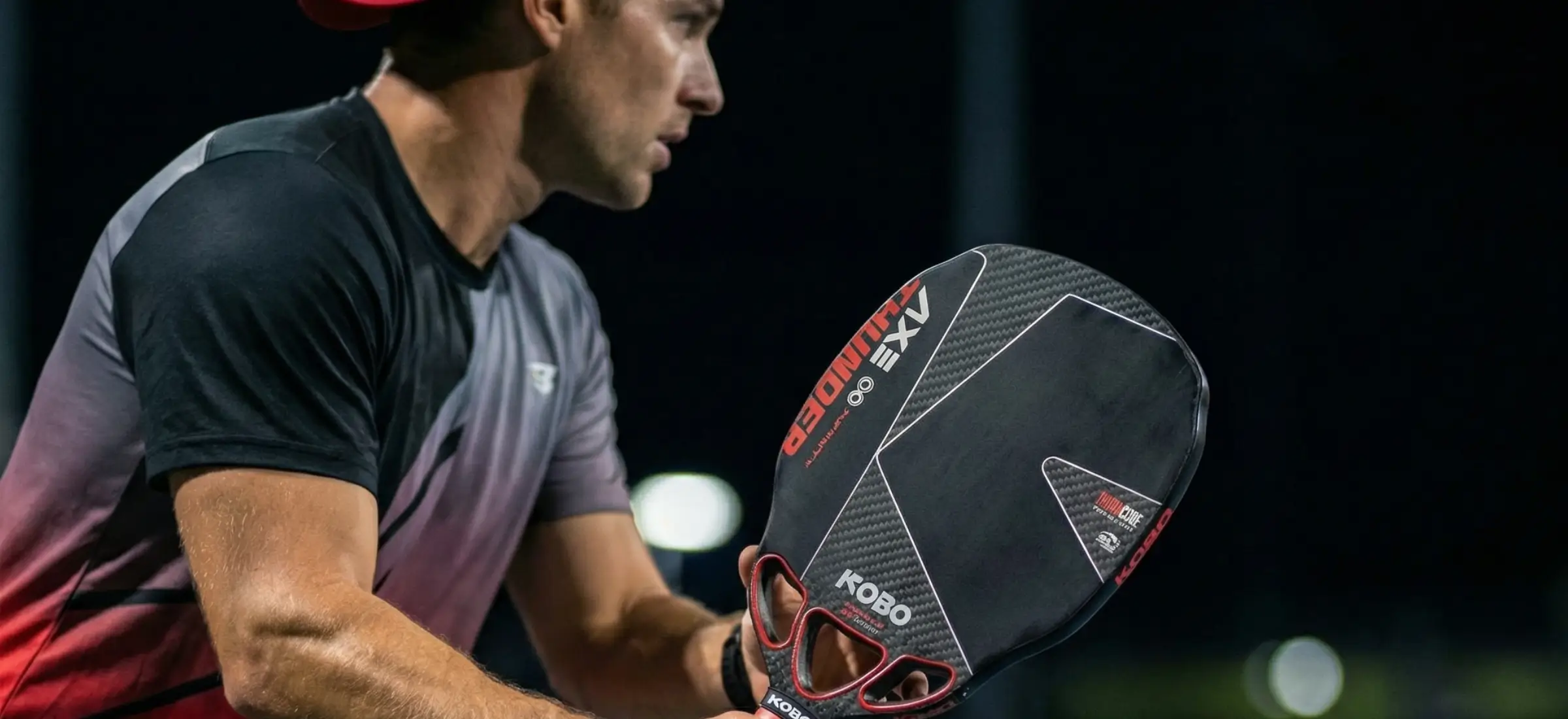
You pick up something that looks like a battle-axe and brace for a heavy swing. Instead, you get right around 8 ounces of paddle (some report a touch under) that players are describing as "surprisingly lightweight."
"While this feels like an axe in your hand, the design makes it fly through the air." — Taylor Gervais, Pickleheads
Those fighter-jet channels in the throat aren't for show — they cut the paddle's resistance so your hands stay fast in a firefight at the net.
The second thing everyone mentions is the sound. Standard paddles crack — that loud, hollow pop you hear across a rec center. The Thunder Axe, struck flush, makes "a totally different sound... a nice little thud." Players describe the feel on contact as "pillowy," "muted," "bitey" — the words you'd use for a high-end table tennis paddle, not a slab of carbon.
That's not an accident. And it's the heart of why this paddle costs what it costs.
So what does $400 actually get you?
Here's the part the skeptics tend to miss when they're busy laughing at the number.
Every grit paddle you've ever owned creates spin the same way: with a rough, sandpaper-like texture sprayed or rolled onto the face. It works... for a while. Then it wears smooth. Within a couple of months of serious play, the spin you paid a premium for quietly disappears, and you're shopping for your next $250–$350 paddle.
KOBO threw that whole model out. Instead of grit, the Thunder Axe uses a proprietary, semi-transparent rubber coating called SoftPlex that feels, in the reviewers' words, "like suede to touch." It doesn't scrape the ball — it grips it, the way a table tennis rubber does, so the ball grabs better off the face and "comes off different." The upshot, according to testers: elite, vicious spin that doesn't wear off the way grit does, because it isn't grit at all.
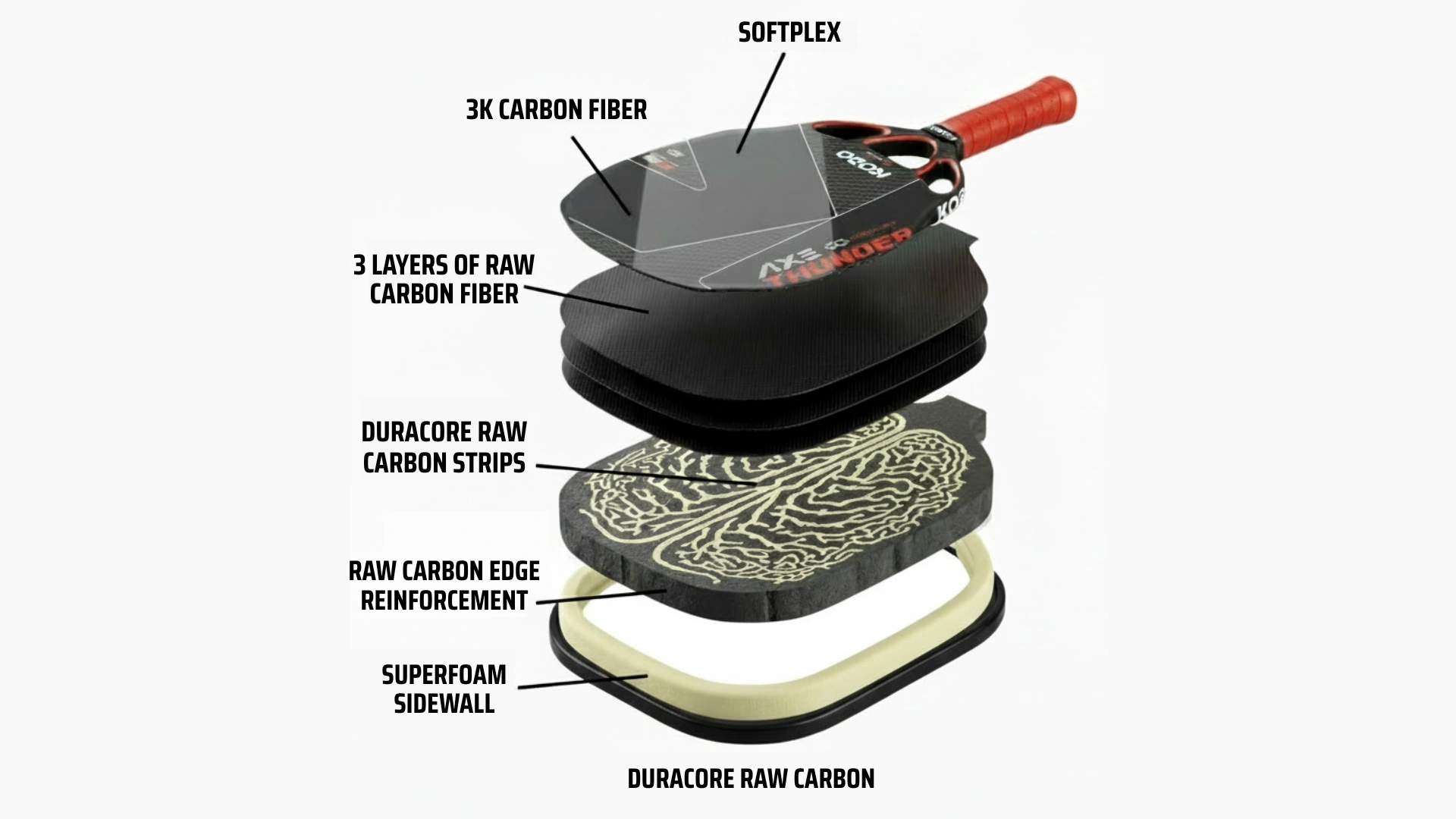
Underneath that face is where the $399 really lives. Instead of the cheap, mass-produced core most paddles hide inside, KOBO builds its DuraCore center by hand — laying the carbon up strip by strip and fusing the whole paddle into a single solid piece, so there are no glued-on parts to rattle loose or deaden the feel. Every one is individually serial-numbered, and the batches are small enough that earlier runs sold out completely.
And then there's the company's actual philosophy, which is the cleanest explanation of the price you'll find: "Engineering Over Endorsements." The big brands spend millions sponsoring touring pros and pass that bill straight to you. KOBO refuses to pay players, and claims it funnels that money into materials and R&D instead. As the brand puts it: "You're not paying for a logo or endorsements."
You can decide for yourself whether that's marketing or mission. But it reframes the question. The argument was never really "why is this paddle $400?" The argument is "what have you been paying $300 for?"
Then the results came in

Talk is one thing. Performance is another.
And this is where the quiet half of the argument gets loud.
Notice what these players have in common. None of them are beginners. None of them are easily impressed. And all of them are describing the same thing the skeptics can't see from the sideline: control that feels almost unfair. One tester said the accuracy was so locked-in it felt "like there's a tiny GPS hidden in the face."
That's the part the price argument never captures. For the right player, the Thunder Axe isn't an expense. It's the paddle that finally made them play — and feel — like the player they've been working three years to become.
So, genius or just hype?
Here's our honest take after all of it.
If you're new to the game, or you swing for winners on every ball, save your money. The skeptics are right about you. This paddle will punish a loose game and make you pay for the privilege.
But if you're a 3.5-and-climbing player who's already burned through two or three "premium" paddles watching the spin wear off each one — if you've hit a ceiling and quietly suspect your gear is part of why you play like everyone else — then the $399 starts to look less like a splurge and more like the last paddle you'll buy this year. No grit to wear out. No edge guard to fall off. One that, by every tournament-winning account we found, plays like nothing else on the court.
The two halves of that argument at open play are never going to agree. But notice which half keeps winning the tournaments — and which half is still asking how much it cost.
Run the math the skeptics skip. A $300 "premium" paddle whose grit wears smooth in a few months isn't a one-time cost — replace it two or three times a year and that's $600–$900 a year on paddles that keep dying. The Thunder Axe is $399 once, with a surface that doesn't wear out. The expensive paddle might be the cheap one.
One catch: they can't make them fast enough
There's a practical wrinkle that comes straight from how the Thunder Axe is made, because every paddle is built by hand — carbon laid down strip by strip, then individually serial-numbered — KOBO can't stamp them out of a mold the way the big brands do. They're produced in limited runs. And those runs have sold out before.
KOBO confirmed it to us directly: the Thunder Axe is their flagship, it's "having a major run on sales," and earlier production batches sold out completely. The company says it has restocked — but given the last stretch of this paddle's reputation, "restocked" tends to be a temporary condition.
It's an unusual kind of scarcity, because none of it is manufactured. KOBO isn't holding inventory back to gin up hype — it physically takes longer to build a paddle by hand than to injection-mold one. The same handwork that justifies the $399 is the same reason there isn't an endless wall of them sitting in a warehouse.
One more thing worth knowing before you go looking: at the time of writing, KOBO is running a code — ORG60 — that takes $60 off, dropping it to $339.
So if you're the player this one is actually built for, the honest advice is simple: don't assume it'll be waiting whenever you get around to it.
Check current Thunder Axe availability
KOBO sells the Thunder Axe directly — but because every paddle is handcrafted, built strip by strip, and individually serial-numbered, they're produced in limited batches. If you've hit a ceiling and you're the player this is built for, see if they're in stock now.
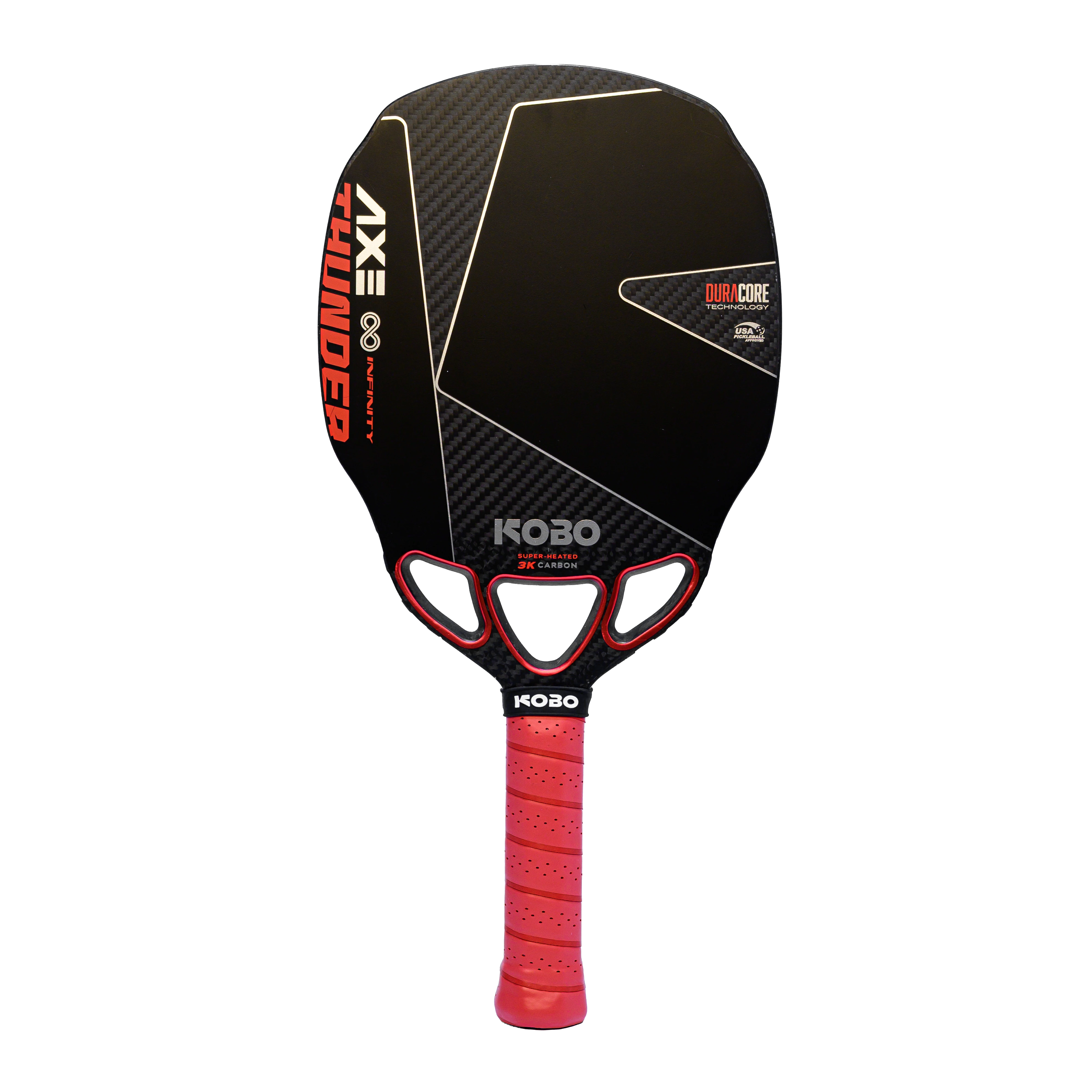
Use code ORG60 at checkout for $60 off — $399 → $339.
CHECK AVAILABILITY →New, unused paddles are covered by a 30-day money-back guarantee.
From the people actually playing with it:
Not a 3.5+ player yet — or not ready for $399? Start with KOBO's mid-tier paddles and come back when you're ready. →